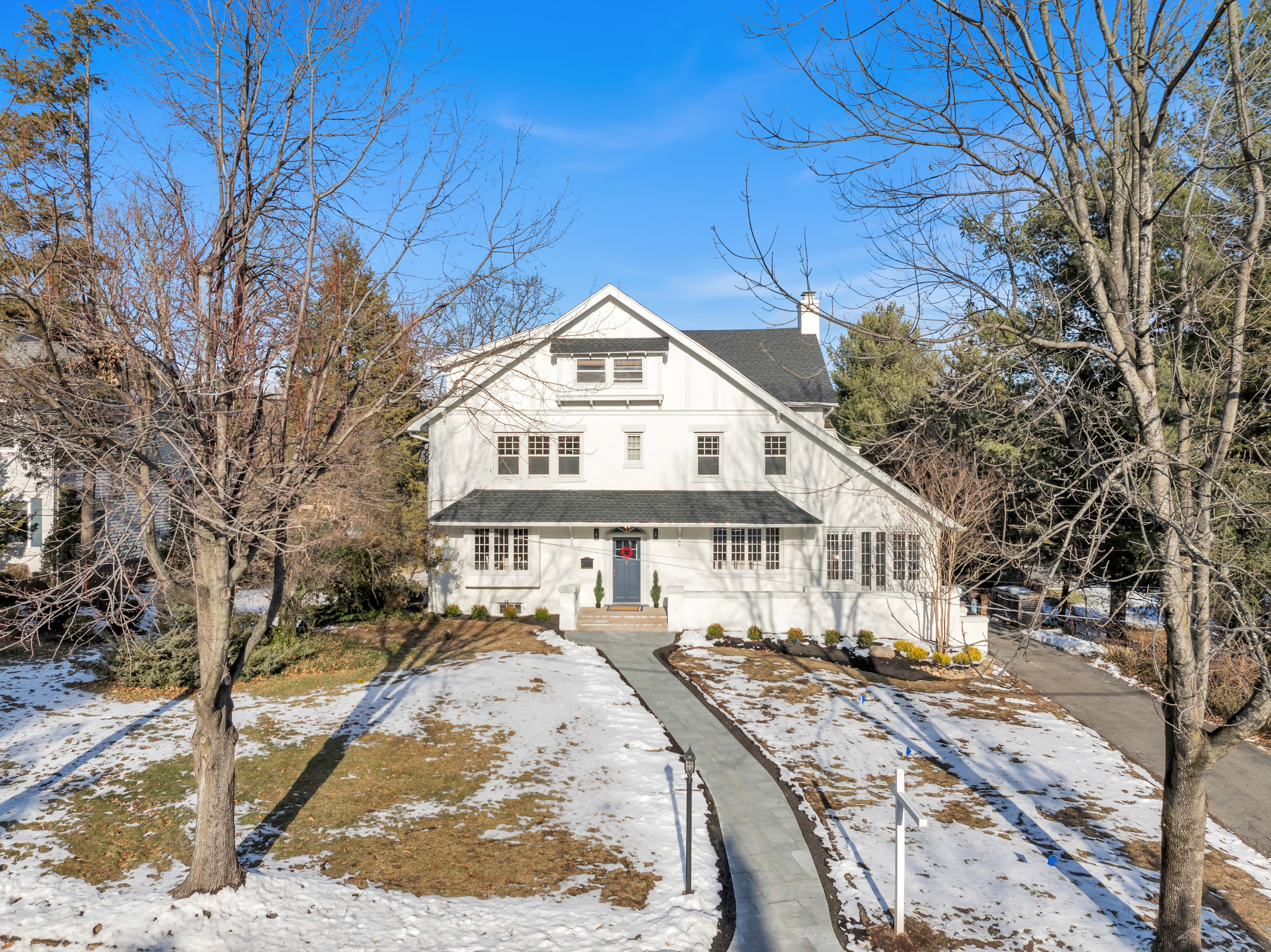
Before there was a "269" Bellair, there was more than land.
By the early years of the twentieth century, the village was no longer emerging; it was advancing. Rail connections were firmly established, institutions were strong, and civic life was active and organized. It was hustling and bustling. Years before the house itself existed, the land beneath it had already been imagined.
As early as 1906, parcels in what was known as Kathawood Park were being actively advertised by the Ridgewood Park Company. Newspaper advertisements spoke not of houses, but of the environment, of the importance of what greeted one in the morning and welcomed one home at night. The language emphasized health, beauty, convenience, and quality of life. These were not speculative lots. They were offered to buyers who understood placement, intention, and the value of building something meant to last.
Perhaps it was this very advertisement that appealed to Mrs. Edith Berry, who arrived in Ridgewood in 1909.
This story begins with a sister who saw its potential, at a moment when Ridgewood had already found its confidence. It was from this development that Edith began purchasing land. She selected a few lots on Bellair Avenue (before it was Rd., it was Ave.), a plot in 1911. The transaction was precise and recorded plainly: land only, a defined parcel, no house yet standing, no number on the door. But the choice itself was far from accidental.
Bellair sat within a carefully planned residential corridor, one already positioned as desirable, aspirational, and forward-looking. After all, the very first golf course had broken ground. The Ridgewood Country Club opened its course on Lincoln Avenue on October 5, 1912, and the three-story clubhouse opened in November 1913.

Not long after the land was purchased, it was conveyed within the family to Edith's sister, Mrs. Estelle Ryder, who was married to Mr. Stephen Remsen Ryder Jr. Contemporary maps capture this moment visually, showing the sisters side by side on adjacent parcels along Bellair, an uncommon and telling arrangement. The conveyance occurred before construction, placing stewardship of the site with Mrs. Estelle Ryder just as the house was about to take form.
Of note, what I find so interesting is how women were making land purchases at a time when their voices weren't always heard and they didn't have the right to vote. But if there's something I've learned about Ridgewood, it is that women have navigated much in relation to the decisions made for the town — especially as it concerned the type of materials the first school would be built from. And if you've never heard the story of the three little pigs, well, they picked bricks!
You see, the women had learned from the large fire that occurred on March 11, 1881, which destroyed much of downtown, and from the fires that followed, that the school had to be brick, and eventually, they won. This also sets the tone for all of Ridgewood to come.
Circa 1912, the residence was built. I don't make this assumption lightly, as the tax records reflect the home being built in 1929, but I can deduce from the first directory published denoting its resident as Remsen Ryder Jr., a broker, h. 167 Bellair Ave. Later Ridgewood Assessment and Sanborn maps will display 167, along with 169, 265, etc., as related addresses, supporting this to be the case.
269 Bellair was constructed in stucco and stone, with solid proportions and a composed presence. The house reflected the values of its era. It was simply built well — if its existence still today would imply, appearing strong, elegant, arising with a towering-like presence, its walls and scale leaving the feeling of a NYC townhome with open staircase, grand entertainment spaces and multi-floor living.
It was about lifestyle. From the beginning, the house was active. This was an era when much of Ridgewood's progress happened inside private homes or on front porches — through women's organizations, charitable committees, church groups, and fundraising efforts that supported education, public welfare, and civic growth. Hosting was not ornamental; it was participatory. Homes like 269 Bellair provided space for ideas to take shape, for plans to be made, and for community gathering, even writing plays performed at their homes. As the women's group of Ridgewood began in 1910, they too may have been members.
As close as the sisters seem to be, it's not surprising that not long after the passing of Edith's husband, Mr. W. J. Berry, in 1931, she moved in with her sister at 269 Bellair and lived in Ridgewood for over 60 years. According to records, Edith's home at 279 Bellair was sold in 1935.
Residents of this part of town were often mentioned in the papers — they were newsworthy. I guess before reality TV, we had the goings-on of people everyone wanted to be like, and the Ridgewood News was always in the know. Even the Ryders' vacation to Connecticut was announced — but none more special, I found, than the announcement of S. Remsen Ryder III's engagement to Ms. Cherry Perkins, daughter of the late Congressman Randolph Perkins, in 1940. She was from Hillcrest Road, and he was from Bellair, both attending Ridgewood High School.
Life unfolded here in all its forms, and soon another family would be the stewards of 269 Bellair.
The Galpins appear in the paper as early as 1949, when Ralph Galpin, age 12, reported his bicycle missing to the police department. It was spring, and I guess after the snow cleared, his sister — the owner of said bike — was looking for it. I wonder if they ever found it! We also get to know Cas Galpin, who appears in 1957, a seventh grader who attended the Brooklyn Dodgers summer camp for boys in Florida. By 1965, we have the announcement of Ralph Galpin, no longer searching for his bike, getting married to Ms. Penelope Ann Tent, where a June wedding was planned.
Later came the Bakers. Paul C. Baker was a commanding officer for the Naval Station in New York. He was congratulated for a job well done in 1966 after two weeks of active duty with the Naval Air Reserve in Jacksonville, Florida. In civilian life, he was a Pan American Airlines pilot at JFK International Airport and married to Claudine. They had seven children. It was in 1973 when we bid farewell to their daughter, Suzanne Marie Baker, as the announcement of her engagement to Theodore John Giardino was published in the Sunday News, where both attended Ridgewood High School.
I can't help but think of all the kids that enjoyed this home — its rooms, its yard, its tree-lined streets, its pool, and everything else Ridgewood had to offer. This house absorbed it all. Now a treehouse — well, fort — stands empty. Erected in 2006 for the four boys that called 269 Bellair home from 2002 to 2021, and awaiting its next resident climber. Who will it be?
Dreams were carried out here. Hopes were tested, and of course, it's inevitable that life also had hard times. But through decades of change, the home remained ready.
"Upper Ridgewood," as it was known then, itself carried distinction — not as display, but as placement within the village's social fabric. Here, even vacations were newsworthy, recorded in print not for extravagance, but because they marked participation in a shared world. Residents moved easily between local commitments and wider horizons, returning always to homes that anchored them. 269 Bellair was one of those anchors.
What gives the house its presence today is not simply age, but continuity. It was built into a moment of belief — belief in place, in progress, and in the idea that a well-chosen plot of land and a well-built house could support generations of life, both ordinary and extraordinary.
No matter what arrived at its door — change, success, uncertainty, joy — the house gathered in. It did not impose itself. It held you.
Jenny Viteritti is a licensed real estate professional and listing agent with Prominent Properties Sotheby's International Realty in Alpine, NJ. For all real estate needs, or questions regarding this story, contact directly at 201-306-6000.